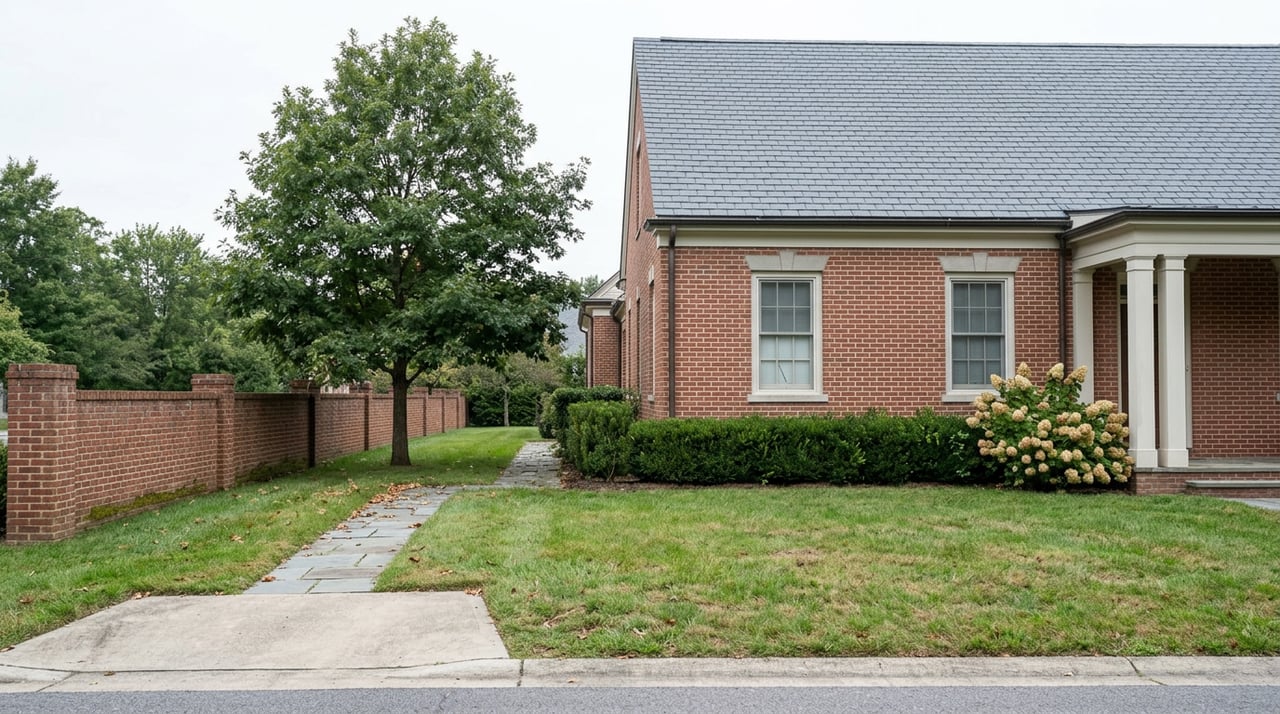
As ARLnow reported in August, "I don't have any skin in the game," the Arlington developer known in county permitting circles simply as Wilson said while explaining why he was stepping back from a Virginia Supreme Court case that could decide the fate of his own projects. Wilson had already sunk money into two Missing Middle townhouse developments, on 25th Street South and N. Quincy Street, when a circuit court judge voided the zoning that made them legal in September 2024. He has said he came close to losing everything he had built over a decade. He is not fighting anymore.
If you are looking at a single-family house in Arlington and pricing in the idea that the lot underneath it might secretly be worth more because it could theoretically hold more housing, Wilson's story is the fact you need before you write an offer. Arlington's Expanded Housing Option, the ordinance behind what most people call "Missing Middle" zoning, has been challenged in court, and ARLnow reported in May 2026 that the case was before the Virginia Supreme Court. The status of redevelopment under EHO in Arlington is not a fixed fact you can look up on a zoning map. It is a live legal question.
A Right That Has Already Been Taken Back Once
According to YIMBY Law, the county board approved the EHO ordinance unanimously in March 2023, and it took effect that July. By the fall of 2024, the county had approved 45 EHO permits, with 12 already holding demolition permits and seven holding building permits, according to Arlington Magazine's reporting at the time.
Then, on September 27, 2024, a circuit court judge ruled against the county on four of six counts, finding it had not properly studied the ordinance's impact and had improperly delegated authority to staff. The ruling did not just block future permits. It voided the ones already issued. In a letter obtained by Arlington Magazine, the county's planning director told developers that any previously approved EHO permit was "now void, or simply put, no longer exists." The county also confirmed it could not refund the permit fees developers had already paid.
That is the detail worth sitting with if you are evaluating a lot for its multifamily upside. This did not happen to a distant hypothetical developer. It happened to real people mid-construction, and the county's answer was that the fees were gone along with the permits.
Where the Case Stands as of September 2026
The Virginia Court of Appeals reversed that ruling in June 2025, but not on the merits of whether EHO is legal. It found the plaintiffs had failed to include "indispensable parties," namely the developers holding EHO permits, in their original lawsuit. That procedural win put EHO back on the books, and the county has continued issuing permits since. ARLnow reported in April 2026 that the county had approved nine additional EHO projects totaling 40 units since the appeals court ruling, with 59 projects listed on the county's permitting dashboard, though some of those had already pivoted back to single-family plans because of the uncertainty.
The plaintiffs appealed that procedural loss to the Virginia Supreme Court, which agreed on May 19, 2026 to take up the case. As the county's own spokesperson confirmed in comments to ARLnow at the time, that review only concerns the procedural question of whether the developers should have been part of the original suit. It does not touch whether EHO itself is legally valid. Plaintiffs filed a 51-page brief on July 29, 2026, and oral arguments on that narrower question are expected this fall. Jason Schwartz of YIMBYs of Northern Virginia summed up the mood to public radio station WMRA in late May, calling the pace "very frustrating" while the uncertainty drags on.
For a buyer, the practical read is this: the county will process a permit application under EHO. But EHO's status has already changed once, and nothing in the current court posture guarantees it won't change again.
What Redevelopment Potential Actually Pays Out
Even setting the legal risk aside, the financial upside of a redevelopment lot is thinner than the phrase "redevelopment potential" implies. Arlington's EHO ordinance also sets project-specific size limits: 4,800 square feet maximum for a duplex, 7,200 square feet for a fourplex, according to details reported in Arlington Magazine's coverage of the policy's rollout. The county also caps new EHO permits at 58 per year across the entire jurisdiction.
David Tracy, president of Alexandria-based homebuilder Classic Cottages, put the economics plainly in Arlington Magazine's reporting: it doesn't make financial sense to put a low-cost home on expensive land, and land in Arlington is expensive. Lot prices can run $800,000 to $1 million for under a quarter acre before a shovel goes in the ground. That cost gets divided across however many units a lot ends up holding, but it doesn't disappear.
The completed projects on the market back this up. A five-bedroom, three-and-a-half bath EHO duplex in the North Highlands neighborhood sold in March 2026 for $1,610,000, and its neighboring unit, a four-bedroom, three-and-a-half bath home, sold in December 2025 for $1,615,000, per ARLnow's reporting on the case. Wilson's own two properties on 25th Street South sold for around $1.2 million each. These are not discount starter homes. They are priced like the premium product they are, because the land under them was never cheap to begin with. A buyer treating the possibility of redevelopment as a coupon for below-market pricing is working from a number that the built product doesn't support.
What to Actually Check Before Paying a Premium for Redevelopment Potential
If a listing's value case rests partly on its multifamily potential, a few concrete steps matter more than the zoning map:
Check the lot's actual status on the county's EHO permitting dashboard rather than assuming zoning alone settles the question. Some lots that looked EHO-eligible have already pivoted back to single-family plans as sellers and builders priced in the litigation risk.
Ask whether the property carries a private deed covenant restricting construction to single-family homes. The county does not proactively flag this for buyers.
Build your closing and construction timeline assuming the legal question stays open longer than anyone currently predicts. Neighbors for Neighborhoods, the group funding the plaintiffs' case, told ARLnow in May 2026 it expected a merits trial within three to six months, which points toward this fall or winter. Court timelines slip often enough that this is a planning assumption, not a date to build a contract around.
A Few Questions Worth Asking Before You Write an Offer
If my permit gets voided after approval, does the county refund the fees? Based on the county's own communication to developers during the 2024 ruling, no. Permit fees were not refunded when EHO was struck down and existing approvals became void.
Should I check for a private deed covenant? Yes. Confirm whether one applies before making an offer.
A lot's redevelopment potential in Arlington right now is real, but it's optionality with a legal discount attached, not a locked-in value add. Knowing where a specific property sits in that permitting and covenant picture, before you write an offer, is the difference between buying upside and buying a lawsuit's outcome.
If you're weighing a single-family purchase in Arlington against its multifamily potential, or trying to figure out what a specific lot's EHO status actually is, Cox & Cox Group can walk the permitting dashboard and deed history with you before you commit to an offer. Contact Us — Let's Solve Your Home Needs.
This article is general information, not legal, tax or financial advice. Consult a qualified professional about your situation.