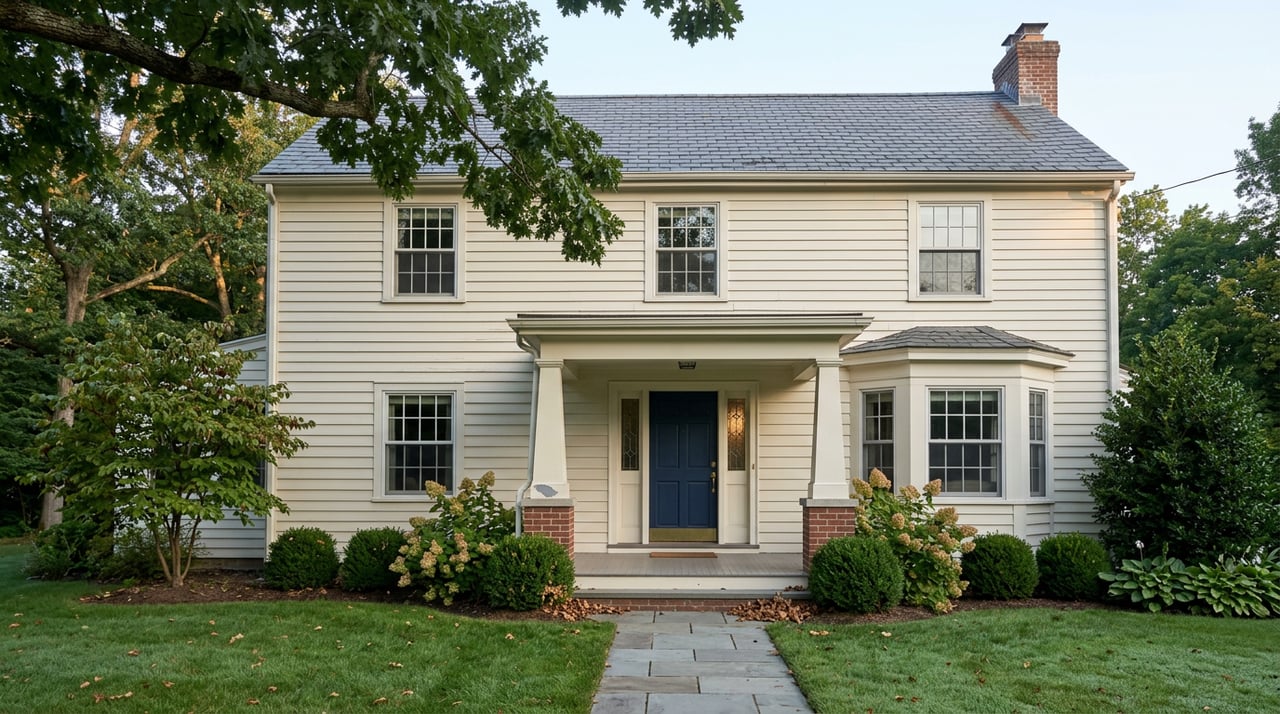
A buyer we spoke with this past spring had two listings pulled up side by side. One sat two blocks off Connecticut Avenue on the DC side of Western Avenue. The other sat two blocks off Connecticut Avenue on the Maryland side. Same architecture era, same lot size, same walk to the Friendship Heights Metro. She assumed she was comparing two versions of the same neighborhood with a jurisdiction label stapled on. She was not. The homes carry different tax structures, sit in markets currently moving in opposite directions, and belong to two places that only share a name because a 19th century streetcar developer liked the sound of it twice.
That gap between what buyers assume and what the numbers actually do is the story of Chevy Chase in 2026.
The Median Everyone Quotes Doesn't Show the Split
Ask for the Chevy Chase median and you'll get a single number that flattens two markets moving in opposite directions.
On the DC side, the three months ending in May 2026 put the median sale price at $1.5 million, up 2.1 percent from the same window a year earlier, with a median price per square foot of $609, up 2.6 percent. Homes there sold in a median of 17 days.
On the Maryland side over that same window, the median sale price came in at $1.3 million, down 9.36 percent year over year, with a median price per square foot of $466, down 6.4 percent. Days on market nearly tripled, moving from a median of 7 days a year earlier to 19 days that spring.
Put plainly: the DC side firmed up while the Maryland side softened, in the same season, under the same interest rate environment, fifteen minutes apart. A neighborhood that markets itself as one continuous historic district produced two different stories depending on which side of Western Avenue you were standing on. Anyone who treats the "Chevy Chase median" as a single data point is averaging together a market that gained ground with one that gave it back.
Roughly Ten Municipalities Share One Name
Part of why the Maryland side behaves less like a single market is that it isn't one. Montgomery County's Chevy Chase area is split among roughly ten incorporated municipalities plus a special taxing district, including Chevy Chase Village, the Town of Chevy Chase, North Chevy Chase, Chevy Chase View, and the numbered sections such as Section 3 and Section 5, with Friendship Heights anchoring the southern edge near the DC line. Each of these governs its own streets, sets its own municipal levy, and bills separately on top of the county and state rate.
DC's Chevy Chase has no equivalent fragmentation. It sits inside Ward 3 as a single planning area with one set of DC-wide rates and one tax authority, the Office of Tax and Revenue. A buyer comparing "Chevy Chase, MD" to "Chevy Chase, DC" as though they were parallel single entities is comparing one government to roughly ten municipalities.
That distinction matters at the closing table, not just in a civics lesson. Two Maryland houses a few blocks apart, both carrying the "Chevy Chase" name in their listing description, can sit in different municipalities with different tax bills and different service levels for something as basic as trash pickup or snow removal.
The Tax Math Most Buyers Never Run
Here is where the assumption most buyers walk in with breaks down. The conventional wisdom says the city taxes more and the suburb taxes less. Run the actual rates and Chevy Chase inverts that.
DC's residential rate for a single-family home, Class 1B, is $0.85 per $100 of assessed value on the first roughly $2.56 million. The DC Fiscal Policy Institute reports a $91,950 homestead deduction. Montgomery County layers three separate rates on top of each other: the state rate of $0.112, the county rate of $0.978, and then a municipal rate that depends entirely on which of those municipalities the property sits in.
| Jurisdiction | Combined rate per $100 assessed |
|---|---|
| DC (Class 1B, after $91,950 homestead deduction) | $0.85 |
| Town of Chevy Chase, MD | $1.0979 |
| Chevy Chase Village, MD | $1.1572 |
Run those rates against the same illustrative $1.5 million assessed value, a round number close to the DC-side median from that spring, and the gap turns concrete. In DC, after the homestead deduction, the bill lands around $11,968. In Chevy Chase Village, the same assessed value produces a bill around $17,358, a difference of roughly $5,400 a year on paper. Even the lower-taxed Town of Chevy Chase comes in around $16,469, still well above the DC figure.
This is a simplified illustration, not a quote for any specific address. Maryland's Homestead Tax Credit caps how fast a taxable assessment can rise year over year, which softens the picture for long-term owners, and DC has its own assessment cap and senior relief programs that change real bills. But the direction holds: the side of Chevy Chase with the lower price per square foot that spring is also the side carrying the heavier property tax structure at a comparable assessed value. A buyer chasing the lower list price without pricing the tax stack is solving half the equation.
What's Being Built on Only One Side of Western Avenue
The two sides aren't just diverging on price and taxes. They're diverging on what gets built next.
In January 2026, the DC Mayor's office selected a proposal to redevelop the Chevy Chase Civic Site, adding a new library, a community center, and 177 units of affordable and market-rate housing. That is new supply, new amenities, and a construction timeline specific to the DC side of the neighborhood. Nothing comparable is currently moving through the pipeline on the Maryland side, where the housing stock is largely fixed by the built-out, low-turnover character that keeps inventory tight across those ten municipalities.
For a buyer weighing the two sides, that's a real difference to price in, not just for near-term construction noise around the civic core, but for what the DC side's supply and amenity base looks like in three to five years compared to a Maryland side with essentially no new housing on the horizon.
What This Means If You're Comparing Both Sides
If you're doing what that spring buyer was doing, holding two Chevy Chase listings side by side across a state line, the comparison that actually matters isn't the sale price. It's four numbers most portals don't put next to each other:
The exact municipality the Maryland property sits in, not just "Chevy Chase," since the municipal levy alone can shift the bill by close to a thousand dollars a year between neighboring towns.
The current assessed value on each property, since the number on a listing sheet may not reflect what either county or district currently has on file.
Whether the DC property qualifies for the homestead deduction.
And the direction each market has actually moved over the past twelve months, not just the current median, since a Maryland list price that looks like a discount against DC's number arrived there by falling, while DC's number arrived by rising.
None of this makes one side the better buy. It makes the comparison an actual comparison instead of two prices sitting next to each other with a state line quietly doing work neither buyer accounted for.
A Few Questions Worth Asking Before You Compare Two Listings
Is "Chevy Chase, Maryland" one town with one tax rate? No. It's roughly ten separate incorporated municipalities and a special taxing district, each billing its own municipal rate on top of the Montgomery County and Maryland state rates. Confirm which one a specific address falls in before assuming a rate.
Which side has the lower property tax bill? On the current rate structure, DC's flat $0.85 per $100 rate produces a lower bill than most Maryland-side municipalities at a comparable assessed value. Actual bills depend on assessment history and available credits on both sides.
Will the 2026 price gap between the two sides keep widening? The research doesn't support a prediction either way. What it supports is that the two sides moved in opposite directions over the twelve months ending in the spring of 2026, which is reason enough to treat them as two markets rather than one.
Comparing two sides of the same name shouldn't come down to guesswork about which government sent the last tax bill. If you're weighing a move across Western Avenue, or anywhere else in the DC metro where a name means more than one thing, Cox & Cox Group can walk the actual numbers with you. Contact us. Let's solve your home needs.
This article is general information, not legal, tax or financial advice. Consult a qualified professional about your situation.